
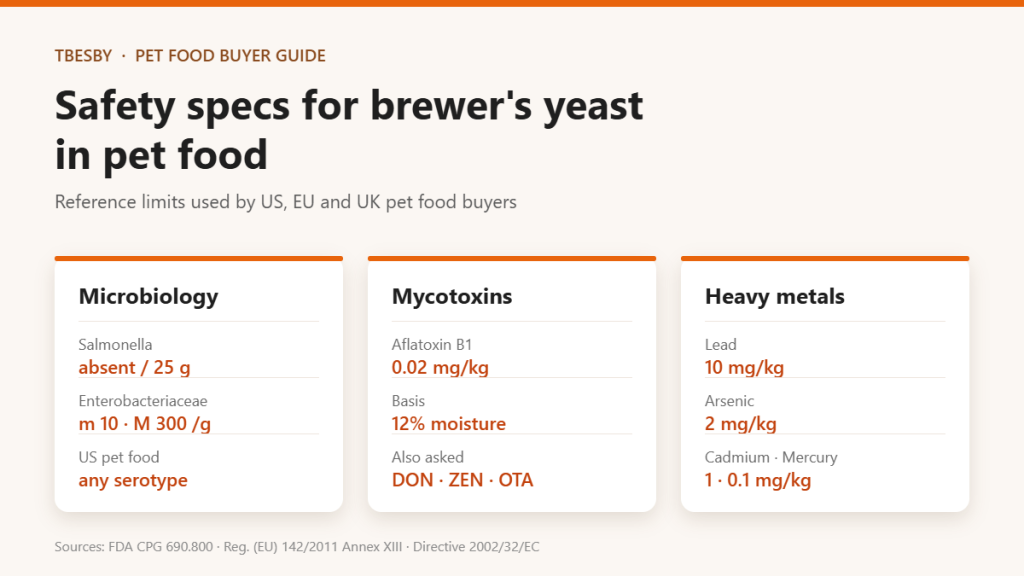
Pet food manufacturers judge dried brewer’s yeast on more than protein. Before an ingredient is approved, their quality teams check three safety areas: Salmonella and other bacteria, mycotoxins, and heavy metals. Pet food is held to a tighter microbiological standard than livestock feed, because dogs and cats live in close contact with people. This guide sets out the reference limits used in the US, the EU and the UK, and the documents a buyer should request from a brewer’s yeast supplier.
Why pet food is held to a tighter standard
In the United States, FDA’s Compliance Policy Guide Sec. 690.800 (July 2013) treats Salmonella differently in pet food and in livestock feed. For pet food and pet food ingredients, FDA staff may recommend seizure or import refusal when Salmonella of any serotype is found and the product will not be heat-treated further. For livestock feed, the same action applies only when the serotype is pathogenic to the animal species being fed. The stated reason is the higher chance of direct human contact with pet food.
In the EU and the UK, Regulation (EU) No 142/2011, Annex XIII, sets the criteria for processed pet food other than canned: Salmonella absent in 25 g (n = 5, c = 0), and Enterobacteriaceae with n = 5, c = 2, m = 10 and M = 300 per gram. These criteria are written for finished pet food made with animal by-products. Brewer’s yeast is not an animal by-product, but manufacturers set their ingredient specifications so the finished product can meet these limits, so the same numbers usually appear in a buyer’s ingredient specification.
Microbiology: what to ask for
- Salmonella: not detected in 25 g, tested by a recognised method.
- Enterobacteriaceae: a count per gram, read against the finished-product limit above.
- Yeast and mould count: useful as a hygiene indicator after drying. Results can differ between laboratories and methods, so the method should be named on the certificate.
Drum drying is a heat step, but contamination risk sits mostly after the dryer: cooling, conveying and packing. Ask how the supplier controls that stage, not only what the final number is.
Mycotoxins
Brewer’s yeast grows on a grain-based wort, typically malted barley with adjuncts such as rice or maize. Mycotoxins present in the grain can therefore carry over into the spent yeast. Directive 2002/32/EC sets the maximum aflatoxin B1 content in feed materials at 0.02 mg/kg (20 µg/kg), relative to feed with 12% moisture. Ask for periodic third-party results for aflatoxin B1 at minimum. If the buyer formulates for the EU, results for deoxynivalenol, zearalenone and ochratoxin A are also commonly requested, because the EU publishes guidance values for them.
Heavy metals
The same directive sets maximum contents for undesirable substances in feed materials, again relative to 12% moisture. The UK kept these limits in retained law. A supplier should be able to show recent third-party results against each one.
| Parameter | Reference limit | Source |
|---|---|---|
| Salmonella (pet food) | Not detected in 25 g; any serotype is actionable in the US | Reg. (EU) 142/2011 Annex XIII; FDA CPG 690.800 |
| Enterobacteriaceae (processed pet food) | n = 5, c = 2, m = 10, M = 300 per g | Reg. (EU) 142/2011 Annex XIII |
| Aflatoxin B1 (feed materials) | 0.02 mg/kg | Directive 2002/32/EC |
| Arsenic (feed materials) | 2 mg/kg | Directive 2002/32/EC |
| Cadmium (feed materials of vegetable origin) | 1 mg/kg | Directive 2002/32/EC |
| Lead (feed materials) | 10 mg/kg | Directive 2002/32/EC |
| Mercury (feed materials) | 0.1 mg/kg | Directive 2002/32/EC |
The documents to request from a supplier
- Product specification with protein, moisture, ash, particle size and the safety limits above.
- Certificate of Analysis with every shipment, with the test methods named.
- Periodic third-party results for microbiology, mycotoxins and heavy metals, from an accredited laboratory.
- Safety Data Sheet for handling and storage.
- Food safety certification of the processing site, such as ISO 22000.
- Market-specific documents: FDA food facility registration and the information needed for FSVP in the US; the feed material name and labelling data in the EU and UK.
- Origin and GMO statements, if the finished product makes claims about either.
A supplier who answers these in one pack, before the sample ships, saves weeks in a pet food approval cycle.
How TBESBY approaches it
TBESBY dried brewer’s yeast is drum-dried at our own facilities in Vietnam from fresh brewer’s yeast supplied by leading international breweries in Vietnam. The product specification covers crude protein of 40–46%, moisture below 10% and ash below 6%, with a 12-month shelf life. TBES is registered with the U.S. FDA, processing is certified to ISO 22000, and every shipment travels with a Certificate of Analysis. The specification and SDS are available on request, and free samples of 1–2 kg are available to qualified buyers.
Related reading: Brewer’s yeast in pet food · How to read a brewer’s yeast CoA · Importing brewer’s yeast into the USA · Importing brewer’s yeast into the EU
Sources
- U.S. FDA. CPG Sec. 690.800 Salmonella in Food for Animals (July 2013)
- Commission Regulation (EU) No 142/2011, Annex XIII, Chapter II: Petfood
- Directive 2002/32/EC on undesirable substances in animal feed, Annex I
Sourcing dried brewer's yeast?
Ask for specifications, a sample or a quote. We reply within 24 hours.